
The call came in on a Tuesday morning. A homeowner in Temecula had a Sub-Zero 648 built-in refrigerator that had been running warm for three days. The freezer was still cold — barely — but the fresh-food section had climbed to 52°F overnight and everything perishable was already lost. She'd had the unit for eleven years and was already looking up replacement prices when she called us.
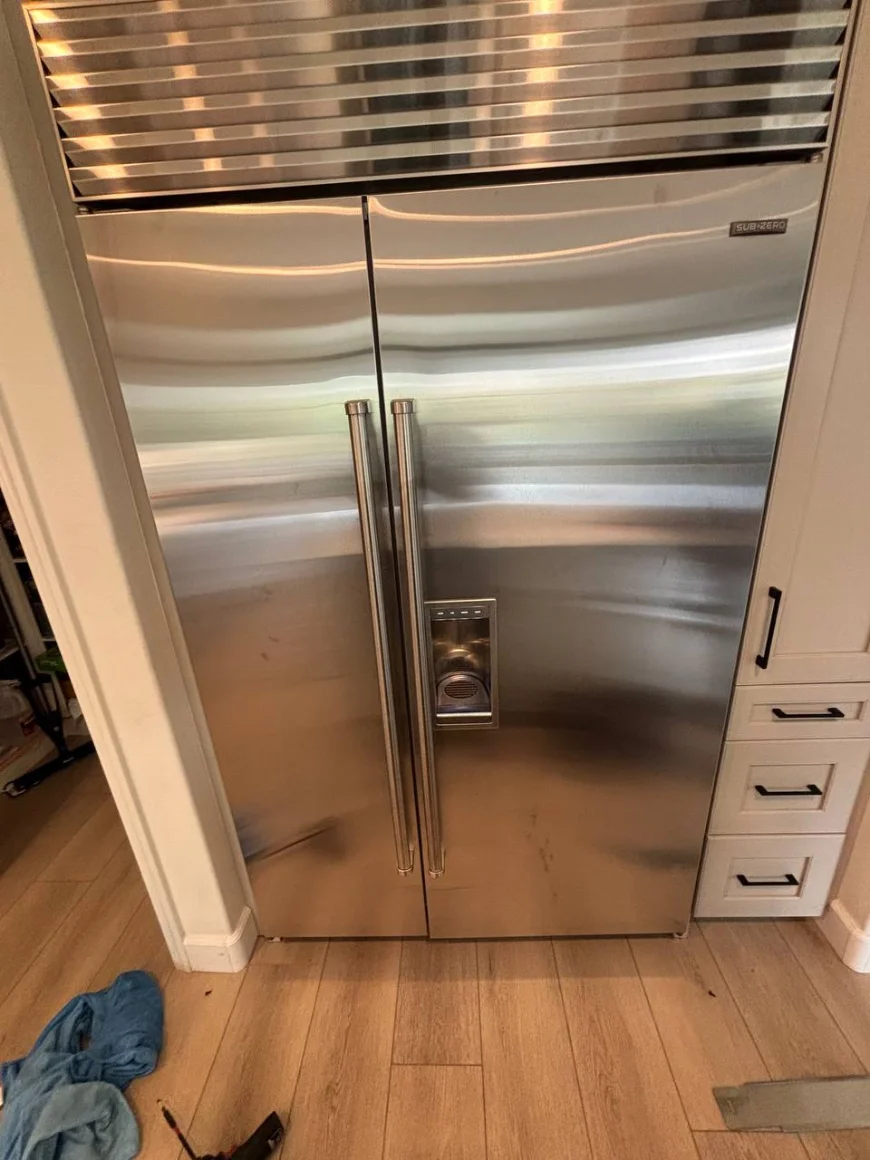
Sub-Zero built-ins are a different beast from the freestanding refrigerators most people own. They're designed to be flush with cabinetry, which means accessing the mechanical components isn't a matter of pulling the unit away from the wall. We knew going in that this would take a methodical approach.
The diagnosis
When we arrived, the first thing we checked was the condenser — Sub-Zero units have a condenser at the top of the cabinet, accessible through the grille above the door. It was coated in a thick layer of dust and pet hair, which can by itself cause cooling problems severe enough to mimic a compressor failure. We cleaned it thoroughly and let the unit run for twenty minutes. Temperature didn't improve.
Next step was checking the evaporator fan and the condenser fan. Both were spinning. No error codes on the control panel display. We attached our manifold gauges to the service ports on the refrigerant lines and read the pressures — and there was our answer. The suction pressure was far lower than it should have been, and the discharge pressure was barely above suction. The compressor was running but not pumping.
A compressor that runs but doesn't compress refrigerant is called a "weak" or "dead" compressor. The internal valve assembly has worn out or failed, and the compressor motor is spinning freely without doing any useful work. It will run continuously, never cool the fridge, and draw power the whole time. This is one of the more expensive refrigerator repairs — the compressor is the heart of the cooling system — but it's still far cheaper than replacing a high-end built-in.
Sub-Zero uses the same compressor across multiple model years. The 648, 642, and 650 series all use a compatible unit, and genuine Sub-Zero replacement compressors carry a 5-year warranty on the part itself — something we always communicate to homeowners, because it meaningfully changes the repair-vs-replace math.
The repair
Accessing the compressor on a built-in Sub-Zero requires removing the toe kick panel at the bottom of the unit, then a secondary access panel behind it. The compressor sits in the lower mechanical compartment. We recovered the remaining refrigerant using EPA-certified recovery equipment — legally required any time you open a refrigerant circuit — then unsoldered the refrigerant lines from the old compressor using a torch and nitrogen purge to prevent moisture from entering the open system.
Once the old compressor was out, we installed the replacement, soldered the line connections, and pressure-tested the entire system with nitrogen to confirm there were no leaks at our solder joints. We pulled a vacuum on the system for 45 minutes to remove all moisture and air, then recharged with the correct weight of R-134a refrigerant as specified on the unit's data plate.
Start-up. The compressor came to life with a noticeably stronger sound than the old one had been making. We watched the gauges normalize over the next fifteen minutes — suction pressure settling where it should, discharge building appropriately. We left a thermometer in the fresh-food compartment and checked back in thirty minutes: 41°F and dropping. Two hours later, 35°F.
What the homeowner saved
A new Sub-Zero 648 lists for around $8,000 to $11,000 depending on configuration. Installation in an existing cabinet cutout, done by a kitchen contractor, typically adds another $500–$1,500. Our repair — compressor, refrigerant, labor, the full job — came to a fraction of that. The homeowner told us she'd been prepared to buy new and we'd just saved her kitchen renovation budget.
That math doesn't always work out this cleanly. If a built-in refrigerator also has a failing sealed system (refrigerant leak in the evaporator or condenser coil), the repair cost can escalate quickly. But a compressor-only failure on an otherwise sound unit is almost always worth repairing, especially on premium brands built with thick steel and high-quality components.
Signs your compressor might be failing
- The fridge runs continuously but can't reach or maintain temperature
- The unit is warm to the touch at the back or sides even after hours of running
- You hear a clicking or chattering sound near the compressor, followed by the compressor stopping — this is the thermal overload protector tripping because the compressor is overheating
- The freezer stays cold but the fresh-food section doesn't — this pattern often points to either a damper problem or a compressor that's barely working
- Electricity bills have gone up without an obvious reason — a struggling compressor draws significantly more current
When to call versus when to replace
Our general guidance: if the refrigerator is under 15 years old and the compressor is the only failed component, repair almost always makes financial sense. If the unit is over 15–18 years old and has had previous repairs, or if you're finding multiple failed components, replacement starts to make more sense. Sub-Zero's build quality means their units often run well past 20 years with proper maintenance — which pushes the calculus toward repair even on older machines.
The best way to know for sure is a professional diagnosis. We don't charge for the assessment if we do the repair, and we'll give you an honest answer even if that answer is "this one's not worth fixing."
Refrigerator not cooling? Let's take a look.
Same-day diagnosis across Riverside & Orange County. We'll tell you straight whether it's worth repairing.
Schedule now