
The call came in from a homeowner in Temecula with an LG WM3900HWA front-loader, about seven years old. The machine had been getting progressively louder during the spin cycle over the previous four months. What started as a mild vibration had evolved into a loud, industrial-grade grinding sound during any spin above 600 RPM. The homeowner had been putting the washer on a "gentle" cycle to avoid the noise, but at that speed the clothes were coming out soaked. She'd gotten a quote from one appliance company that suggested just replacing the whole unit.
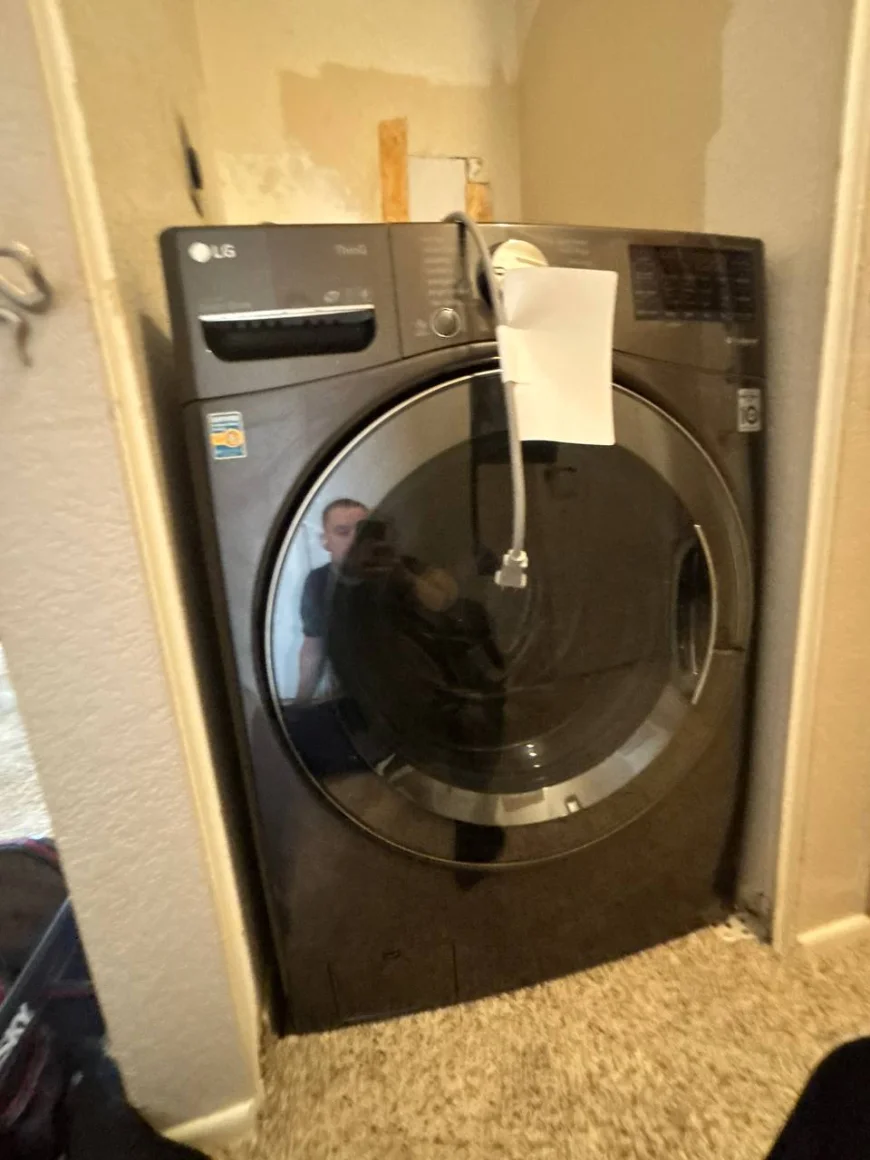
We disagreed with that assessment. A seven-year-old LG front-loader is not end-of-life by a long stretch, and a drum bearing failure — which this clearly was — is a repairable problem, not a terminal one.
What drum bearings do and why they fail
The drum in a front-load washer spins on a bearing assembly at the rear of the machine. This bearing supports all the weight and rotational forces of the drum — which can hold 15–20 pounds of wet laundry and spin at 1,200 RPM or more on a high-speed cycle. The bearing is a sealed unit: two ball bearings pressed into a housing, with a rubber seal on each side to keep water and detergent out and bearing grease in.
Over time — typically 7–12 years on a heavily used machine — the seals degrade. Water gets into the bearing, the lubricating grease washes out, and metal-on-metal contact begins. Initially this produces a mild rumble. As the bearing deteriorates further, the balls deform and the inner race wears — the grinding gets louder and the drum develops slight lateral play, which you can sometimes feel if you grab the drum and try to move it side to side with the door open.
Secondary damage happens when the seal behind the bearing (the drum seal or rear tub seal) also fails. This seal prevents wash water from reaching the bearing. Once it goes, every wash cycle introduces more water into the bearing housing, accelerating the wear dramatically.
Early warning sign: a low rumble or growl during high-speed spin that wasn't there six months ago. Catching it at this stage — before the inner race wears and the drum has lateral play — means a simpler bearing swap rather than a full bearing-and-drum-shaft rebuild.
The repair process
LG front-loader bearing replacement is a substantial disassembly job. The bearing is pressed into the rear tub half, which means the tub has to come apart to access it. On the WM3900, the sequence is: remove the front panel, remove the door seal (a bungee cord-style spring holds it on), remove the door hinge, remove the top panel, disconnect all hoses and wiring from the tub, unbolt the counterweights (cast iron blocks that balance the drum), remove the drum assembly from the cabinet, split the tub halves (they're heat-welded together and have to be separated carefully), press out the old bearing, press in the new bearing, replace the drum seal, and reassemble everything in reverse order.
On this machine, we found the inner bearing race had slight scoring — early wear but not catastrophic. The drum seal was also compromised, which was the source of the accelerating damage. We replaced both the bearing and the drum seal with LG OEM parts. We also inspected the drum shaft itself while it was accessible and confirmed it wasn't scored — shaft scoring would have required a full drum assembly replacement and significantly higher cost.
Total time on site: about 3.5 hours. We ran two test cycles at full spin speed before leaving. Silent. The homeowner stood in the laundry room listening to confirm it was the same machine.
When bearing replacement isn't worth it
Drum bearing replacement is a significant labor job, and the math changes on older machines or those with additional problems:
- If the drum shaft is scored or bent, replacement cost climbs significantly — a new drum assembly on some LG models runs $200–$350 on top of labor, at which point the total repair may exceed 60–70% of a new machine's cost.
- If the machine is over 10–12 years old and has had previous significant repairs, the remaining lifespan may not justify the investment.
- If the machine also has a failing door seal (visible mold, water leaking from the door), a problematic control board, or other developing issues, stacking repairs gets expensive.
In this case: 7 years old, no other issues, drum shaft intact, bearing and seal replacement only. The math was clearly in favor of repair, and the homeowner got what should be another 5–7 years of reliable service out of a machine she was happy with.
A note on front-loader bearing noise vs. other noises
Not all front-loader spin noise is a bearing. Worth ruling out before calling:
- Thumping rhythmically during spin: usually an unbalanced load. Redistribute the laundry and run again.
- Rattling during spin: something in the drum — a coin, a button, a bra underwire in the tub seal groove. Check before assuming mechanical failure.
- High-pitched squealing at the start of spin that goes away: often the door seal rubbing on the drum rim. A worn or misaligned door seal, not a bearing.
- Grinding that's present during wash agitation, not just spin: could be a foreign object caught in the tub-to-pump path, not a bearing.
Bearing failure is specifically a grinding or roaring sound that correlates with drum rotation speed — louder as spin speed increases — and is consistent from cycle to cycle.
Washer making a grinding sound?
Same-day washer repair across Riverside & Orange County. We carry bearing kits for LG, Samsung, and Whirlpool.
Schedule now