
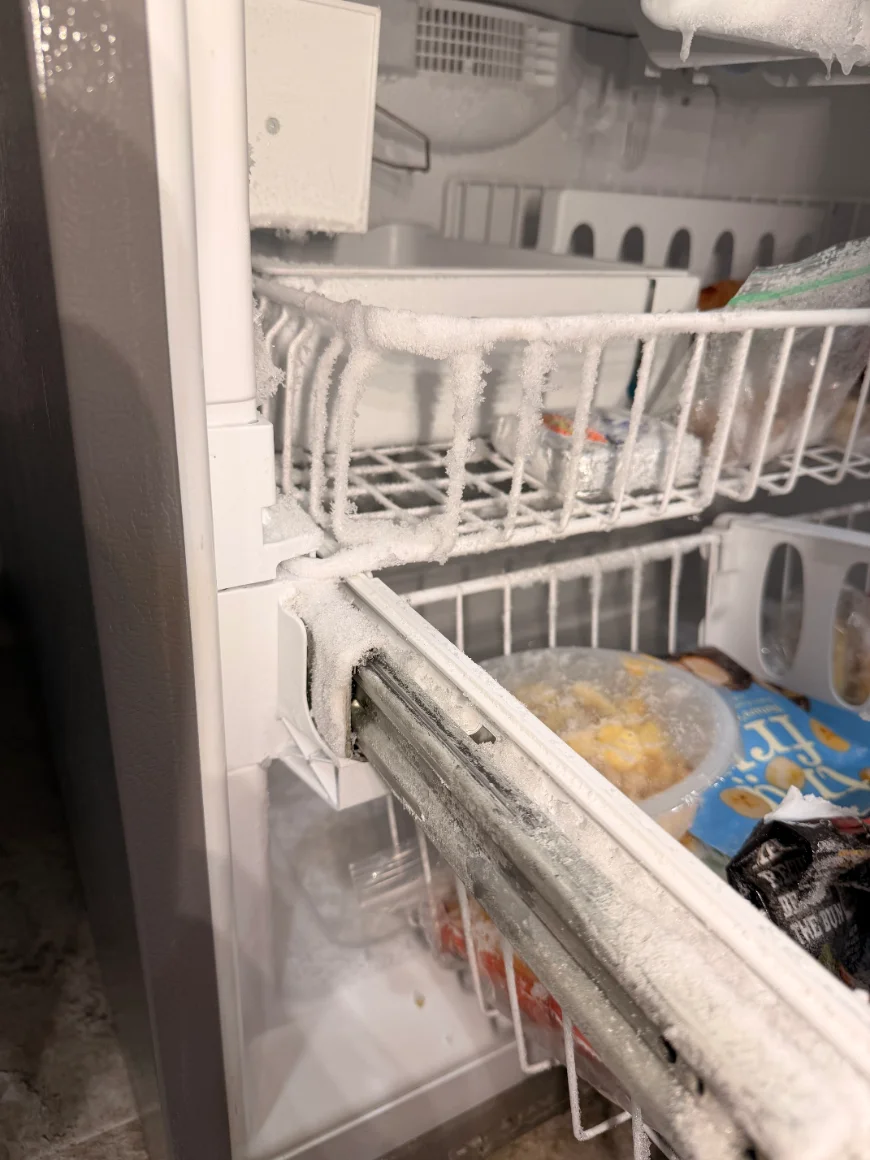
You notice the ice maker has stopped producing ice. You open the freezer, remove the ice bin, and find the ice maker module is completely encased in a solid block of ice — or you pull out the bottom freezer drawer and discover the entire rear panel is covered by a thick sheet of ice that's pushed your food storage bins out of position. Either way, something has gone wrong with the defrost system, and the problem usually starts at the defrost drain.
This is closely related to the refrigerator water leak we covered in another article, but the ice maker version has some distinct characteristics worth understanding separately.
Why the ice maker area freezes over
Modern refrigerators with ice makers in the freezer run regular automatic defrost cycles to melt accumulated frost off the evaporator coils. That melt water is supposed to flow down through a drain hole at the bottom of the freezer section and exit through a drain tube to the pan under the fridge. When the drain is blocked — by mineral scale, food debris, or a frozen plug of ice at the bottom of the tube — the water has nowhere to go.
It refreezes. But because the ice maker area is specifically cold and often has less airflow than the rest of the freezer, this refreezing happens preferentially there. The ice accumulates cycle after cycle — each defrost cycle adds a layer — until you have a significant ice buildup that eventually engulfs the ice maker module, blocks its water fill tube, and stops production entirely.
A secondary but common cause: the water fill tube that runs from the back of the freezer wall to the ice maker mold can freeze if the freezer temperature is running slightly too cold, or if there's a partial airflow obstruction near the tube. This doesn't involve the defrost drain at all — the water simply freezes in the tube before it can reach the ice mold. You'll know this is the cause if the ice maker module itself is fine (no clicking error, no frozen housing) but no ice is produced and the water dispenser (if equipped) still works.
Safely thawing the ice maker
The safest approach is a controlled manual defrost — not a full kitchen-floor defrost of the entire freezer, which wastes food and takes hours, but a targeted thaw of just the ice maker area:
- Remove all food from the freezer and store it in a cooler with ice.
- Turn off the ice maker using the shutoff arm or the control panel setting.
- Place several towels on the freezer floor under the ice maker area.
- Fill a turkey baster with warm (not boiling) water and pour it slowly over the ice buildup. Work from the outside in — don't force the ice maker module.
- Alternatively, a hand-held steamer on a low setting works well and is faster. Avoid heat guns — they can warp plastic components at close range.
- As ice melts, catch the water with the towels and replace them. The drain hole should be visible once the floor ice clears — pour a cup of warm water into it to confirm it drains freely. If it doesn't drain, the tube is still blocked and needs clearing (see our refrigerator water leak article for the full procedure).
- Once the area is clear, dry all surfaces with a cloth, check the ice maker fill tube is free of ice, and restore power.
Don't use a knife, screwdriver, or ice pick to chip ice away from the ice maker module. These tools can puncture the refrigerant line behind the rear freezer panel — a small hole that releases refrigerant, stops cooling, and turns a $150 repair into a $600–$900 sealed-system repair.
When the defrost heater has failed
If you thaw everything out, the drain flows freely, the fill tube is clear, and the same ice buildup returns within one to two weeks — the defrost heater or defrost thermostat has failed. The freezer is running defrost cycles but the heater isn't generating enough heat to melt the frost, and the drain is getting overwhelmed by accumulated frost rather than defrost melt.
You can roughly confirm this: after the freezer has been running normally for a few days, open the freezer and pull out the bottom shelf. Look at the rear evaporator cover panel. If the panel feels solid-ice cold and there's frost visible around its edges, the defrost system is not keeping up. A functioning defrost system keeps the evaporator cover panel frost-free (or nearly so) between cycles.
Defrost heater replacement requires removing the freezer's rear panel to access the evaporator — it's a straightforward repair for a technician, typically 45–90 minutes depending on the model. Common models we see this on: LG LRMVS3006S, Samsung RF28, Whirlpool WRF757SDHZ.
What to do with the fill tube
If the fill tube that supplies water to the ice maker was frozen, the cause is almost always one of three things:
- Freezer temperature set too low. Below 0°F, the fill tube is more likely to freeze. Set the freezer to 0–5°F for optimal ice production and food safety.
- The fill tube heater has failed. Most ice maker fill tubes have a small heater coil wrapped around them to prevent freezing. When this heater fails, the tube freezes regularly. The heater is a $20–$40 part and its replacement is simple once the rear panel is removed.
- Airflow obstruction near the tube. If bags of frozen food are pushed against the back wall and blocking airflow from the evaporator fan, cold air concentrates near the fill tube. Clear the area around the evaporator fan outlet.
Ice maker stopped working?
Same-day refrigerator repair across Riverside & Orange County. We carry common ice maker parts on the truck.
Schedule now