
A dishwasher that runs through a full cycle and delivers gritty, food-spotted dishes is one of the more frustrating appliance problems — partly because the machine seems fine. It turns on. It makes the right sounds. It finishes and beeps. Everything looks normal except the dishes are dirty.
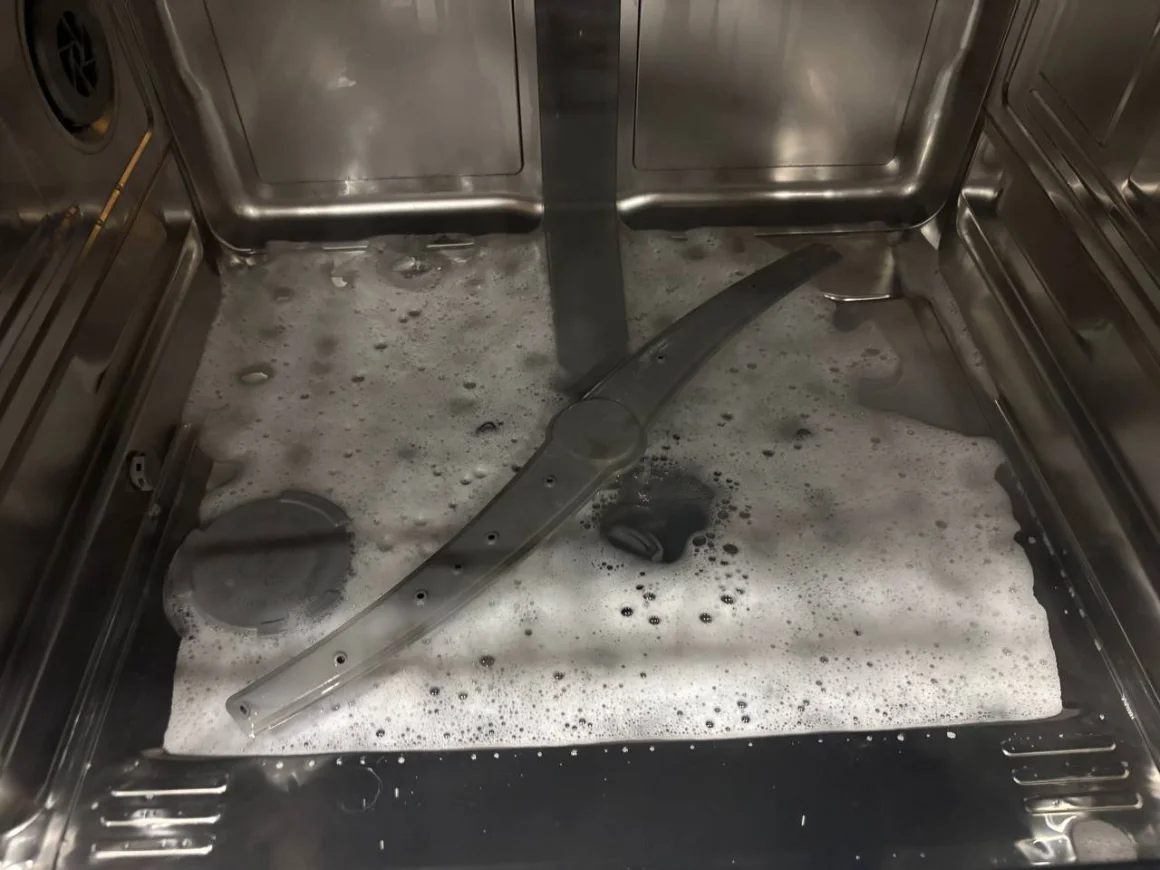
Before you blame the detergent or start running vinegar cycles, it's worth understanding what's actually happening mechanically. In our experience, dishes that come out unclean after a full wash cycle are most commonly caused by insufficient water entering the machine — and the most likely cause of that is a failing water inlet valve.
What the water inlet valve does
The water inlet valve is an electromechanical solenoid valve mounted at the back lower corner of the dishwasher, where the supply hose connects. When the dishwasher's control board signals the start of a fill cycle, the valve opens and allows water to flow in. When the tub reaches the right water level (or a timed fill completes, depending on the model), the valve closes.
A fully functioning valve opens completely, allowing adequate water flow to fill the tub in the time allotted by the control cycle. A partially failing valve — the much more common scenario — opens only partway, restricting flow. The tub doesn't fill fully. The wash arms don't get enough water pressure to spin properly and reach the upper rack. Detergent doesn't dissolve or distribute adequately. Result: a full cycle with inadequate cleaning.
The Bosch call in Irvine
We got a call from a homeowner in Irvine with a Bosch Series 500 — a SHPM88Z75N, about four years old — that had progressively worsened over about two months. Initially the top rack was coming out with food residue. Then the bottom rack started having problems too. The customer had tried changing detergents, adjusting the rinse aid level, cleaning the filter (which was clean), and running a dishwasher cleaner cycle. Nothing helped.
When we arrived, the first thing we checked was the fill. We ran a manual fill cycle and watched the tub through the door. On a Bosch 500, the tub should reach a water depth of roughly half an inch to an inch at the bottom during a normal fill. The water was barely covering the bottom — maybe a quarter inch. The wash pump was running fine, the spray arms were intact and unblocked, but there simply wasn't enough water to wash with.
We pulled the lower access panel and checked the inlet valve. Bosch dishwashers use a double-solenoid inlet valve — one solenoid for the main wash fill, another for the rinse aid dispenser. We disconnected the valve and checked flow with the supply water on: the flow rate was significantly below specification. The valve was opening, but only partially. Calcium scale from the area's hard water had partially clogged the valve's internal screen and stiffened the solenoid plunger.
Hard water accelerates inlet valve failure. The valve screen — a small mesh filter inside the valve body where the supply hose connects — accumulates mineral deposits over time. In high-TDS water areas like the Inland Empire and much of Orange County, this screen can restrict flow significantly within three to five years. Cleaning the screen periodically (it's accessible by disconnecting the supply hose) can extend valve life.
The repair
We replaced the inlet valve with a Bosch OEM part — using aftermarket valves on Bosch dishwashers is something we avoid, as the solenoid timing is matched to the control board's fill cycles and off-brand valves sometimes cause false water-level errors. With the new valve in place, we ran a fill cycle and watched the tub fill correctly. Ran a full normal wash with a soiled load from the customer's sink. Dishes came out clean. Job done.
Other causes of dishwasher cleaning failure
The inlet valve is our first check because it's the most common cause, but it's not the only possibility. In roughly the order we check them:
- Clogged filter assembly. Most modern dishwashers (especially European-style Bosch, Miele, and Thermador) have a manual-clean filter at the bottom of the tub. It should be removed and rinsed every 2–4 weeks. A badly clogged filter restricts water recirculation and dramatically reduces washing effectiveness. Many homeowners don't know the filter exists.
- Blocked spray arms. The upper and lower spray arms have small holes that can become clogged with hard water deposits or debris. Remove them (they typically unscrew or unclip) and flush them under a tap, using a toothpick to clear individual holes.
- Wash pump impeller debris. Small pieces of broken glass, plastic, or food can jam or partially block the wash pump impeller, reducing spray arm pressure. You can often hear this as an unusual sound during the wash cycle — a grinding or rattling.
- Water temperature too low. Dishwashers depend on hot water to dissolve detergent and sanitize dishes. If your hot water heater is set below 120°F, or if the dishwasher is at the far end of a long plumbing run and the water hasn't reached temperature before the fill completes, cleaning will suffer. Most Bosch models have an internal heater that boosts water temperature, but it extends cycle time and doesn't fully compensate for very cold incoming water.
- Failing control board. If fill, wash, and drain times are all slightly off — inconsistent cycle behavior rather than a consistent specific problem — the main control board may be sending incorrect signals to the components. This is less common but more expensive to repair.
Quick self-check before calling
- Remove and rinse the filter (it's at the bottom of the tub — twist and lift on most models).
- Remove the spray arms and flush each hole under running water.
- Check that the supply valve under the sink is fully open.
- Run the hot water at your kitchen sink for 30 seconds before starting the dishwasher — this clears the cold water from the supply line so the machine fills with already-hot water.
- Load dishes per the manufacturer's recommendations — overloading and blocking the spray arm rotation is a surprisingly common cause of poor cleaning.
If you've done all of the above and the problem persists, the inlet valve is the next thing to investigate — and that's where a technician is useful, because confirming a valve failure requires measuring water flow rate, not just observing whether the machine fills.
Dishwasher running but not cleaning?
Same-day dishwasher diagnosis and repair across Riverside & Orange County.
Schedule now