
Home / Blog / Five Signs Your Dryer Is About to Quit
🌀 Dryer
Five Warning Signs Your Dryer Is About to Quit
📅 June 4, 2026 ⏱ 4 min read ✍️ Easy Home Repair Team
Dryers don’t usually die without warning. The problem is that the warnings are easy to ignore — a cycle that takes a little longer than it used to, a noise you’ve gotten used to, clothes that come out slightly damp but dry enough. By the time the dryer actually stops working, most homeowners are already facing a bigger repair bill than they would have had a few months earlier.
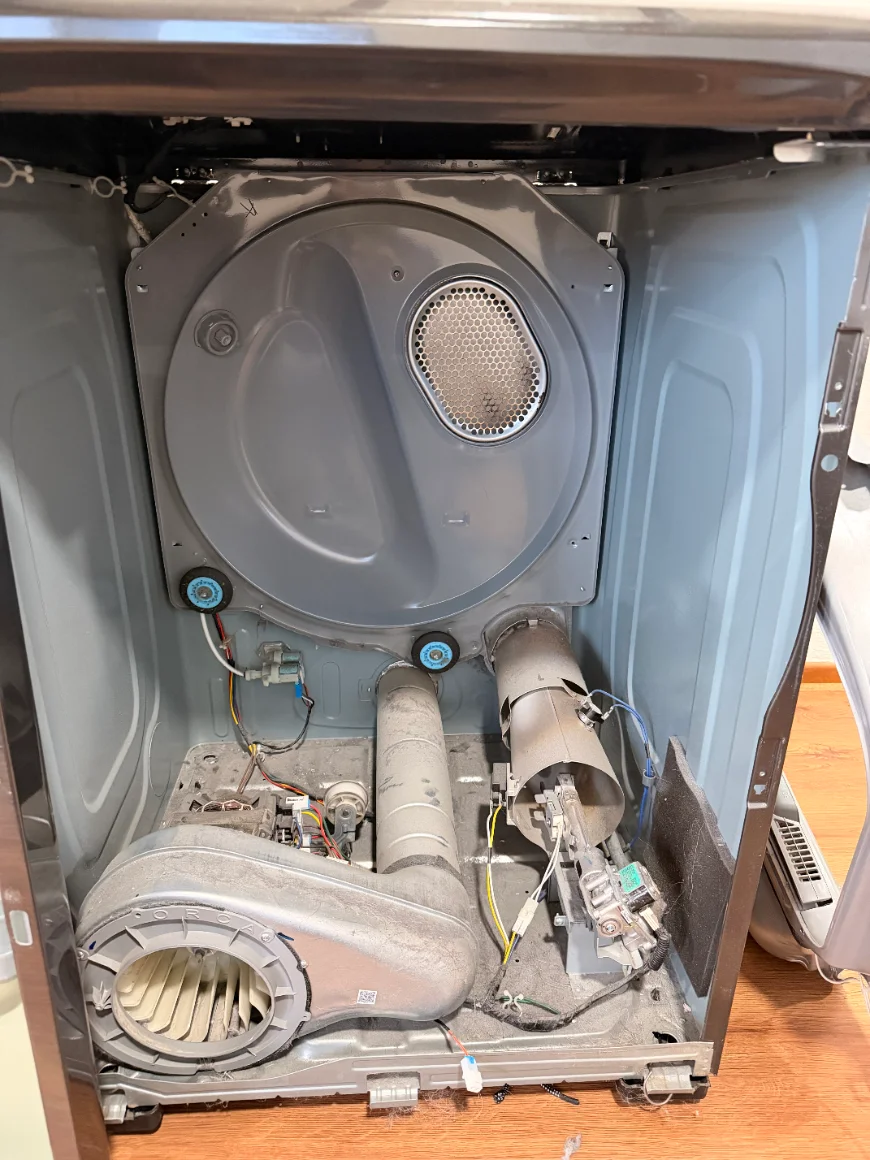
Here are the five signs we see most often in the weeks and months before a dryer completely gives out — and what each one usually means.
1
Clothes take more than one cycle to dry
This is the most common complaint we hear, and it’s almost never caused by one thing. The most likely culprits, in order of frequency:
- Clogged exhaust vent. Lint accumulates in the dryer duct over time, reducing airflow. Without proper airflow, moisture can’t escape the drum — the dryer runs but doesn’t dry. This is also a fire hazard; the U.S. Fire Administration estimates that dryer vent fires cause around 2,900 home fires per year. If you haven’t had your vent cleaned in the past year, start here.
- Worn heating element (electric dryers). Electric dryers have a coiled heating element inside the heater box. When it partially fails — one coil breaks while others remain intact — the dryer produces some heat, but not enough. Clothes come out warm and damp.
- Failing gas valve coils (gas dryers). Gas dryers have a set of solenoid coils that open the gas valve during operation. When one coil starts to fail, the burner ignites for the first few minutes then shuts off, leaving the dryer to tumble without heat for the rest of the cycle.
- A faulty cycling thermostat. The cycling thermostat regulates the drum temperature during a cycle. If it’s reading falsely high, it will cut heating too early and your clothes will never fully dry.
Quick test: Start a timed dry cycle with a wet towel, then open the door after five minutes and feel the air inside the drum. It should be noticeably warm to hot. If it’s cool or only slightly warm, you have a heat-source problem, not a vent problem.
2
A grinding, squealing, or thumping noise during the cycle
Dryers are mechanical machines — a drum rotating inside a cabinet, supported by bearings and rollers, driven by a belt. Most abnormal sounds point to one of these components wearing out.
- High-pitched squealing or squeaking usually means the drum glides (the felt pads or plastic slides that support the front of the drum) are worn thin and metal is starting to contact metal. Left alone, this progresses to metal-on-metal grinding that can score the drum housing.
- A rhythmic thumping — thump-thump-thump with every revolution — is typically a worn drum support roller. These are rubber rollers that the drum rests on at the rear, and they flatten out over time. The repair is inexpensive; ignoring it eventually transfers stress to the drum bearings and drive belt.
- A grinding, metallic scraping sound often means the rear drum bearing (a ball bearing or sleeve bearing, depending on the model) is failing. This is a more involved repair but still very worth doing on a machine that’s otherwise sound.
- A rattling sound when the drum spins but not when it’s stationary is usually a loose item inside the drum — a coin, a zipper pull, a button. Check the drum seams and the front bulkhead gap before calling anyone.
3
The dryer stops mid-cycle
A dryer that turns itself off before the cycle finishes has usually activated a safety shutoff. There are two common reasons:
Thermal fuse blown. Every dryer has a one-shot thermal fuse mounted on the exhaust duct or heater box. If the dryer overheats — usually because of a blocked vent — the fuse blows and cuts power to the heating circuit or the entire dryer, depending on the model. On some dryers, the thermal fuse blowing means the machine runs but produces no heat; on others it means the machine won’t start at all. A blown thermal fuse is a $5–15 part, but if you replace it without clearing the blocked vent, the new fuse will blow again quickly.
High-limit thermostat failing. Similar to the thermal fuse but resettable — this thermostat trips when temperatures exceed a safe threshold and resets when the dryer cools down. A dryer that stops mid-cycle, then starts again after sitting for ten minutes, points squarely at the high-limit thermostat or a blocked vent causing repeated overheating.
Don’t ignore a dryer that stops mid-cycle and restarts. A dryer cycling through thermal shutoffs is telling you it’s overheating. Overheating dryers are a significant fire risk. Have the vent and the thermostat checked before continuing to use it.
4
The drum doesn’t spin
You press start, the dryer hums, but the drum doesn’t move. Or the drum moves freely by hand but stops the moment the dryer is running. This is almost always a broken or slipped drive belt.
The drive belt is a long, thin rubber belt that wraps around the drum, around an idler pulley, and then around the motor shaft. When it snaps — which eventually happens to every belt — the motor runs but has nothing to turn. The drum sits still. Belts are inexpensive parts; labor is the main cost of this repair because the dryer cabinet needs to come apart to access and reroute the new belt.
If the drum doesn’t spin and you also hear a buzzing or humming from the motor compartment, the motor itself may have failed. Motor replacements are more expensive and push the repair cost higher — this is one of the cases where we’ll give you an honest assessment of whether repair makes sense relative to the machine’s age and value.
5
The dryer gets unusually hot on the outside
It’s normal for a dryer to be warm on the top and sides during operation. It’s not normal for it to be hot enough that you can’t comfortably rest your hand on the top panel, or for the door or cabinet to radiate significant heat.
Excessive external heat almost always indicates a ventilation problem — the hot air that should be exhausting through the duct is instead backing up inside the cabinet. Run your hand along the exhaust duct from the dryer to the wall while the dryer is running. You should feel warm air moving through the duct. If the duct feels cool or you can’t feel airflow, the duct is blocked somewhere between the dryer and the exterior wall cap.
External dryer heat can also indicate a failing or mispositioned heating element — one that’s radiating heat into the cabinet rather than directing it into the drum airflow. This is more common after a previous repair where the heater box wasn’t fully reassembled.
What to do when you notice these signs
Most of these problems start small and escalate. A squealing dryer that runs fine otherwise might be three months from a seized bearing and a completely failed drum. A slow-drying dryer might be one lint buildup away from a thermal fuse — or a fire.
The practical advice: don’t wait until the dryer fully stops working. A technician can diagnose most of these issues in a single visit, and the repair cost when you catch problems early is almost always lower than when you wait for a complete failure.
We offer same-day dryer repair across Riverside and Orange County. If you’re seeing any of these signs, give us a call — we’ll tell you straight what it is, what it costs, and whether it’s worth fixing.
Dryer acting up? We can be there today.
Same-day dryer repair across Riverside & Orange County. 6-month warranty on all work.
More from the blog
Repair Story
LG Front-Load Bearing Rebuild After a Loud, Grinding Spin
Repair Story
The Samsung Washer That Wouldn’t Drain — What We Found Inside
Maintenance