
A homeowner in Murrieta had been dealing with an annoying problem for about three weeks: one burner on his Viking VGCC5366BSS 36-inch range kept clicking after the flame lit — sometimes for thirty seconds, sometimes for two or three minutes straight. The other five burners worked fine. He'd cleaned around the igniter with a toothbrush, made sure the burner cap was seated properly, and dried everything out after the last time a pot boiled over. Still clicking.
Persistent clicking after ignition is one of Viking's most common reported issues, and the cause is almost always one of three things: moisture in the igniter module, a misaligned burner cap, or a cracked or carbon-fouled igniter. We had our parts inventory stocked for Viking before we even confirmed the diagnosis.
How Viking burner igniters work
Viking ranges use a spark ignition system — each burner has a ceramic spark igniter mounted next to the burner head. When you turn a knob to the ignite position, a module sends a series of high-voltage sparks to all igniters simultaneously (not just the one you're turning), which is why you sometimes hear clicking from multiple burners when you light one. The igniter module uses a ceramic body with an embedded electrode; a tiny spark jumps between the electrode and a ground point on the burner cap.
The ceramic insulator on these igniters is porous at a microscopic level. When the insulator gets contaminated — with food residue, grease, or moisture — it becomes slightly conductive. The spark module then fires continuously because the high-voltage circuit can't build up the proper charge before discharging through the contamination. Hence the clicking that won't stop.
The diagnosis
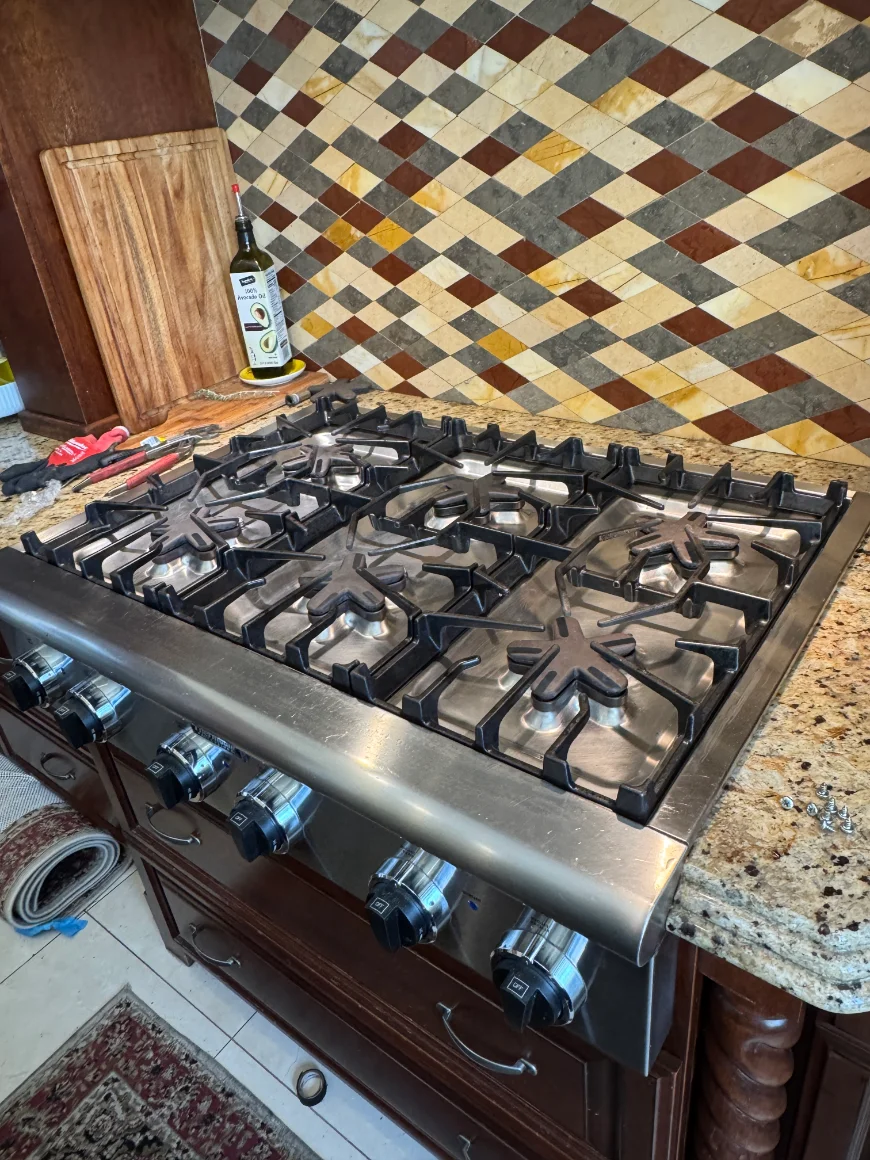
We pulled the burner cap off the offending burner, removed the burner grate, and inspected the igniter closely. The ceramic body had visible dark carbon deposits around the base — the result of a boilover that had cooked onto the igniter housing. We tried cleaning it with a cotton swab and rubbing alcohol while the range was disconnected from power, then dried it with a heat gun. This sometimes resolves the issue when the contamination is primarily moisture-based.
It didn't work in this case. Under normal light the carbon deposits looked superficial, but under inspection they had penetrated the ceramic body itself — the insulator was permanently compromised. The igniter needed to be replaced.
Viking igniter replacement note: Viking uses igniters that are specific to their burner configuration — the spark gap, the ceramic geometry, and the connector type vary between their 36-inch, 48-inch, and all-gas vs. dual-fuel models. Using a universal igniter is a common mistake that either doesn't spark reliably or sparks at the wrong gap. We always use Viking OEM or a verified manufacturer-equivalent part.
The repair
On a Viking range, replacing a surface burner igniter means disconnecting the range from gas and power, removing the cooktop (six screws on this model, cooktop lifts off from the front), disconnecting the igniter's two-wire harness from the igniter module, and threading the new igniter up through the same mounting hole. The whole job — diagnosis, part confirmation, disassembly, replacement, reassembly, and test — took about 45 minutes.
We reconnected power and gas, turned on the repaired burner, and lit it. Flame came on immediately, clicking stopped the moment the flame established. We tested all six burners to confirm the module was functioning correctly for the others. Everything normal.
What Viking owners should know about maintenance
Viking ranges are built for longevity, but they require more attentive cleaning than consumer-grade ranges because they're designed for high-output cooking — boilovers happen more often with powerful burners, and the igniters are particularly exposed. A few habits that significantly extend igniter life:
- Clean igniters after any boilover immediately — once the range has cooled, wipe the igniter body with a dry cloth, then follow with a cotton swab dipped in rubbing alcohol. Don't use water directly on the igniter.
- Never spray cleaners directly onto the cooktop surface. Spray onto a cloth, then wipe. Liquid cleaner that runs into the igniter housing is the primary cause of moisture-related continuous clicking.
- Check burner cap seating after every cleaning. Misaligned caps don't ground the igniter spark properly and cause the module to keep firing.
- If one burner clicks intermittently while others don't, clean and inspect that specific igniter before the contamination hardens. A problem caught early is a cleaning job; caught late, it's a part replacement.
Viking's parts availability is excellent, and most of their surface components are still stocked for models going back 15+ years. If you have a Viking range that's developing burner issues, the prognosis for repair is almost always good — the machines are designed to be serviced, and most repairs are straightforward once you have someone with the right parts and experience.
Viking range acting up?
We carry parts for Viking and all major premium brands. Same-day service across Riverside & Orange County.
Schedule now