
You put a sheet of cookies in the oven, set it to 350°F, and walk away. Twenty minutes later one side is golden brown and the other side is barely beige. Or the bottom burns before the top sets. Or your roast is perfectly done on the outside but raw in the middle despite hitting the right internal temperature on your probe.
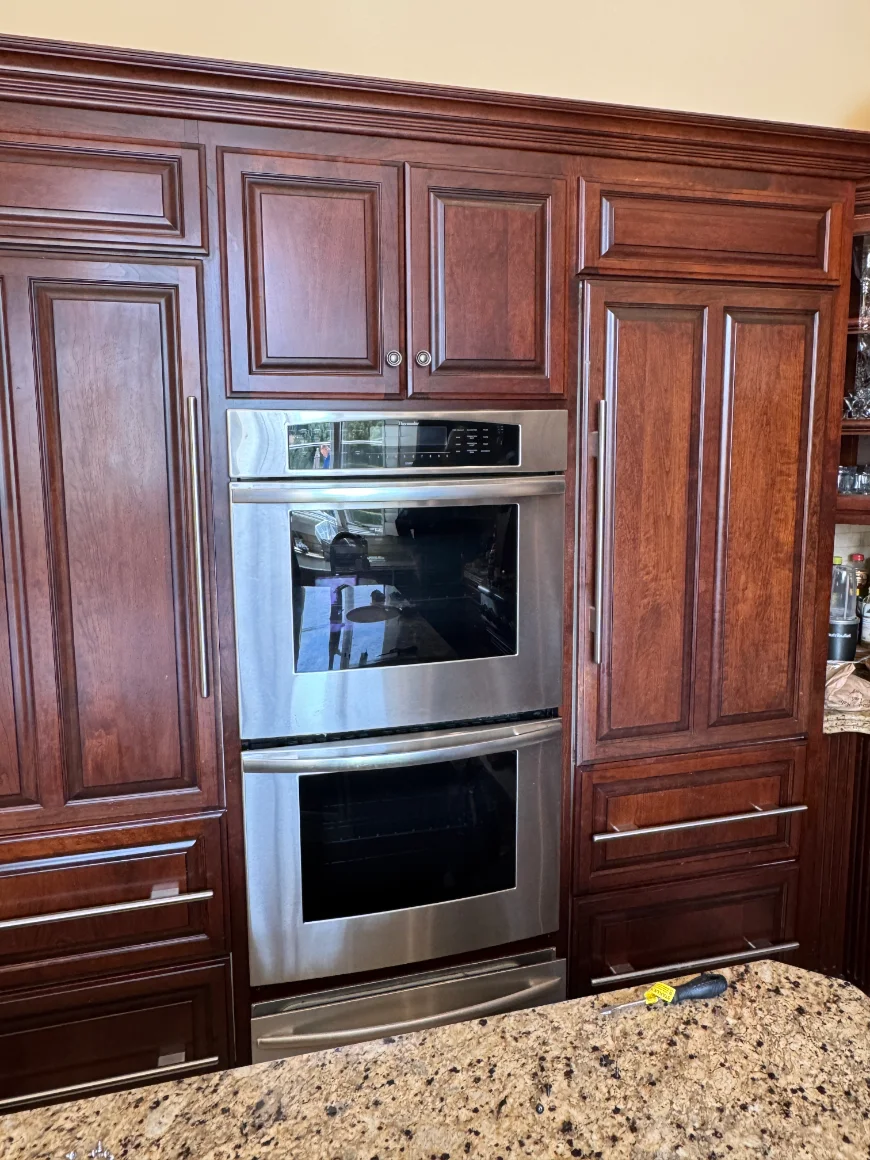
Uneven oven heat is one of the most common complaints we hear — and it's worth distinguishing between two different problems that look similar but have different causes: a thermostat that reads the wrong temperature, and an oven that heats unevenly across the cavity.
Temperature drift vs. uneven heat distribution
Temperature drift means your oven says 350°F but actually runs at 320°F or 390°F. Every element heats and shuts off on cue — the thermostat just has the wrong reference point. This shows up as everything undercooking (thermostat reading too high — oven shutting off early) or overcooking (reading too low — oven running too long). The heat is even across the cavity; you just have the wrong temperature.
Uneven heat distribution means the oven reaches the right overall temperature but hot and cold spots exist within the cavity. One area near the element runs hotter than the rest. This is a different problem — typically a failing bake or broil element that's not heating uniformly, or a convection fan that's not distributing air properly.
The cookie test distinguishes them clearly: bake a sheet of cookies without rotating. If every cookie is the same shade of wrong (all pale or all dark), you have temperature drift. If some are burnt and others are raw, you have distribution issues.
Diagnosing the thermostat
The oven thermostat (also called the temperature sensor or oven sensor, depending on the design) works differently in older analog ovens versus modern electronic models.
In older gas and electric ranges — pre-1990s roughly — the thermostat is a mechanical device with a sensing bulb mounted inside the oven cavity and a bellows-type mechanism that opens and closes contacts based on temperature expansion. These are remarkably reliable but they drift over decades as the sensing fluid slowly escapes or the calibration changes. Many of these thermostats have an adjustment screw that allows calibration without replacement — a technician can measure the oven's actual temperature with a calibrated probe and adjust the thermostat accordingly, typically within a range of ±35°F.
In modern electronic ranges — everything made in roughly the last twenty years — the thermostat is a resistance temperature detector (RTD), a thin probe mounted inside the oven cavity that changes electrical resistance as temperature changes. The control board reads that resistance and converts it to a temperature. RTD sensors rarely drift; more commonly they fail outright (cracked sensing element, broken wire, corroded connector) or the control board develops a calibration error.
Check your oven's calibration offset first. Most modern ranges allow you to offset the oven temperature from the control panel — typically accessed by holding the Bake button for several seconds. If your oven consistently runs 25°F cool, you can dial in a +25°F offset without any repair needed. Check your range manual for the procedure. On Samsung, GE, and Whirlpool this is a standard feature.
When the bake element is the real culprit
Electric oven bake elements glow red when working correctly. If yours heats unevenly, visually inspect it during a preheat cycle (from a safe distance — don't touch). A healthy element glows evenly its entire length. A failing element will have one section that doesn't glow, or that glows dimmer than the rest — a partial break in the heating coil. This creates a permanent hot spot at the sections that still work and a cold area where the broken coil sits.
Element replacement is one of the more accessible oven repairs for a homeowner — the element typically mounts with two screws and has two electrical connectors. If you're comfortable working near electrical connections (with the power off), it's a reasonable DIY job. If not, or if the element is a sealed hidden-bake style (common on self-cleaning ovens), it's a technician job.
Gas oven hot spots: the burner and the igniter
Gas ovens heat by burning gas through a burner tube at the bottom of the oven. The flame should be even and blue across the entire burner. If you see orange or yellow patches, or if the flame looks uneven, the burner ports may be clogged with grease or the igniter is producing an inconsistent spark. Both create uneven heat distribution.
Gas oven igniters also have a measurable operational lifespan. The igniter must draw enough current to both open the gas valve (via a safety mechanism) and spark. A weak igniter draws slightly less than the required threshold — the gas valve opens slowly, gas accumulates, and when it finally ignites it does so with a small pop and an uneven initial flame. This is particularly noticeable right at the start of a bake cycle and tends to improve once the oven is up to temperature, but the early uneven heating affects the first 15–20 minutes of any bake.
A practical test you can do tonight
You need an oven thermometer — they cost $8–15 at any kitchen store. Place it in the center of the middle rack. Preheat to 350°F. Once the oven signals it's preheated, wait an additional 10 minutes (ovens are rarely fully stable the moment they signal ready). Then check the thermometer.
If it reads within 15°F of your set temperature, your thermostat is fine. If it's off by more than 25°F, either calibrate via the offset setting or call a technician. Move the thermometer to different positions in the oven during a second preheat to identify whether specific zones read differently — this tells you whether distribution (not just calibration) is the issue.
Oven not heating right? We'll fix it today.
Same-day oven repair across Riverside & Orange County. 6-month warranty on all work.
Schedule now